
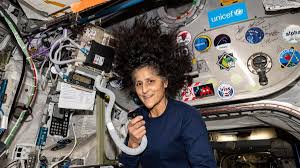
NASA has officially announced the retirement of one of its most celebrated astronauts, Sunita “Suni” Williams, ending a 27-year career that redefined endurance, leadership, and resilience in human spaceflight. Williams’ journey — marked by historic records, astonishing missions, and a dramatic nine-month extension aboard the International Space Station (ISS) — has captured the attention of space enthusiasts and the global public alike.
Thank you for reading this post, don't forget to subscribe!At age 60, Williams stepped down from NASA on December 27, 2025, leaving a legacy that stretches far beyond her time in orbit. With 608 cumulative days in space, she ranks among the agency’s most experienced astronauts and holds the record for the most spacewalk hours by a woman — a total of 62 hours and 6 minutes across nine spacewalks.
🚀 From Shuttle Missions to Marathon in Microgravity
Williams’ spaceflight story began in 2006 aboard the Space Shuttle Discovery, and her remarkable path continued through three missions to the ISS. Her early flights helped build momentum for international cooperation in space research, and she served in commanding roles during multiple expeditions.
One of her most memorable feats occurred in 2007 when she became the first person to run a marathon in space, completing the Boston Marathon aboard the ISS treadmill — an act that symbolized human spirit and adaptability even beyond Earth’s atmosphere.
In 2012, she returned to the ISS aboard a Russian Soyuz spacecraft and later held a leadership role as a station commander — showcasing technical prowess and international collaboration.
🔧 The Starliner Test That Turned into a Historic 9-Month Mission
Perhaps the most extraordinary chapter of Williams’ career unfolded in June 2024, when she and fellow astronaut Barry “Butch” Wilmore launched aboard Boeing’s Starliner spacecraft for the spacecraft’s first crewed test flight. The mission was originally planned to last about a week, but a series of technical problems with the Starliner’s systems prevented a safe return as scheduled.
Rather than ending after a short stay, the mission transformed into an unexpected nine-month tenure aboard the ISS — a dramatic extension that tested routines, research schedules, and even how astronauts live far longer than anticipated in microgravity.
Williams and Wilmore continued daily scientific experiments, spacewalks, and public engagements, sharing rare insights into long-duration space habitation. Their prolonged stay ended in March 2025, when a SpaceX Crew-9 spacecraft was dispatched to bring them home safely.
Despite widespread media descriptions of them being “stuck,” both astronauts later clarified that they never felt abandoned and trusted mission control and their support teams throughout the extended stay.
👏 A Legacy of Leadership and Inspiration
NASA Administrator Jared Isaacman praised Williams as a “trailblazer in human spaceflight,” whose contributions advanced scientific understanding and helped pave the way for future missions, including NASA’s Artemis program aimed at returning humans to the Moon and eventually Mars.
Williams’ impact extended beyond records. She played pivotal roles in astronaut training, operational leadership, and international space collaborations — inspiring generations of young scientists, engineers, and explorers worldwide.
Her retirement was celebrated not just within NASA but across global space communities. Many see her career as a testament to courage, commitment, and scientific curiosity — a human story of adventure and resilience that transcends typical news coverage.
🌌 What Comes Next?
While Williams has stepped back from active astronaut duties, her influence is expected to continue in other ways. Like many retired astronauts, she may pursue public speaking, space advocacy, and roles in education and private space ventures, helping to shape the future of exploration beyond Earth orbit.
As NASA embarks on new frontier missions and international partnerships, the foundation laid by pioneers like Suni Williams will remain a guiding beacon for what humans can achieve when curiosity meets courage.
